Artificial intelligence is no longer only a tool that helps scientists sort data faster. A new Dædalus special issue frames a deeper question: if AI can model proteins, suggest materials, design experiments and help interpret huge datasets, how much of discovery will still depend on human judgment?
The answer is not simple. AI is already accelerating parts of science, but the most important discoveries still require testing, explanation, reproducibility and trust. The future is likely to be a scientist-machine partnership, not a clean handover from people to algorithms.
What happened
Dædalus, an open-access publication of the American Academy of Arts and Sciences, published a Winter/Spring 2026 special double issue titled AI & Science: What Is the Future of Discovery? The issue is edited by James M. Manyika and gathers responses from 33 scientists across life sciences, medicine, neuroscience, climate, chemistry, materials science, computer science, mathematics and social science.
The collection argues that AI is starting to affect not only what scientists can discover, but how science is done. Its essays discuss protein prediction, virtual cells, drug discovery, brain mapping, climate modeling, astronomy, AI in medicine, autonomous laboratories and the philosophical question of whether machines can become scientific agents.
The bigger picture
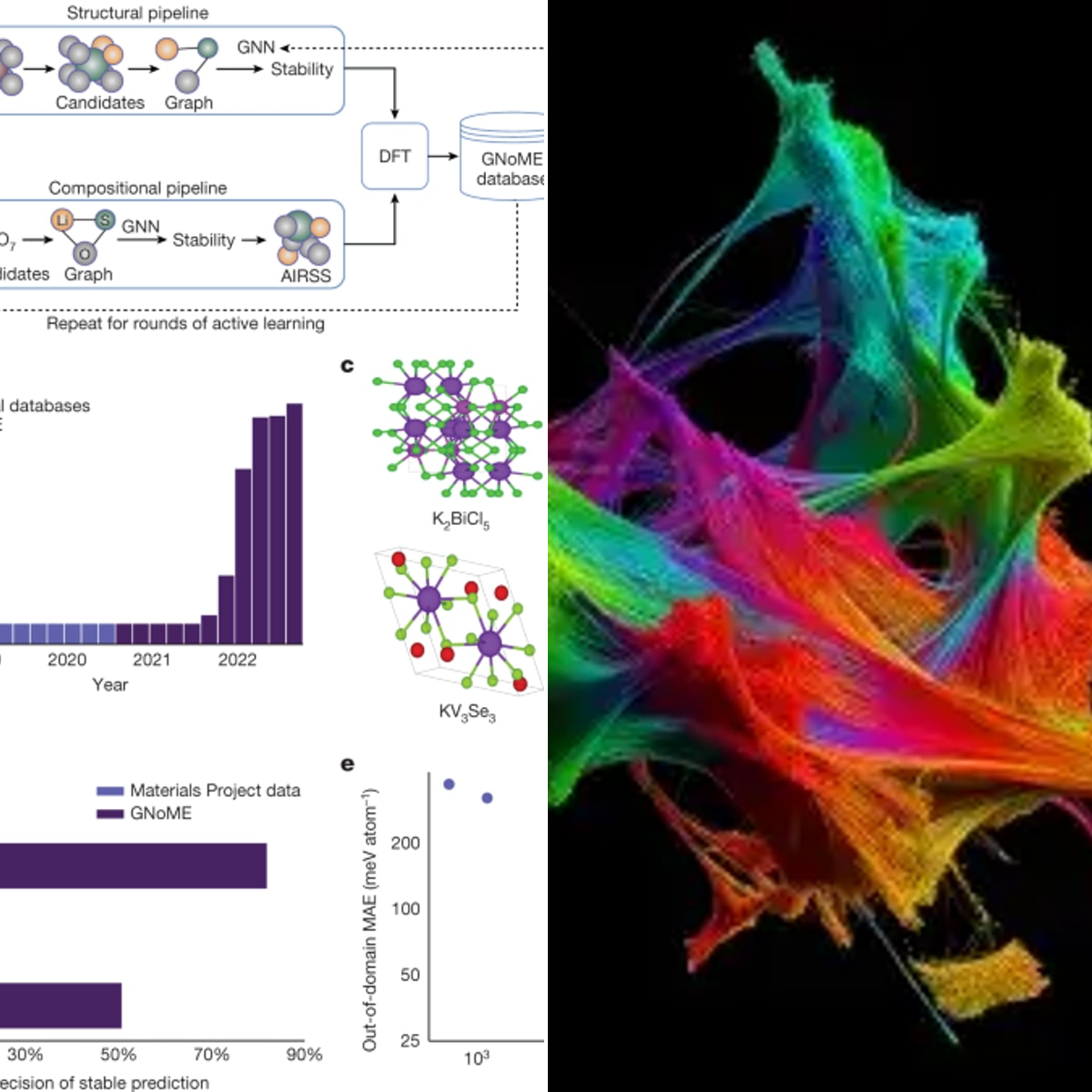
Recent examples show why this debate matters. The AlphaFold Protein Structure Database provides open access to more than 200 million predicted protein structures, giving researchers a faster starting point for biology and disease research. In materials science, the GNoME project reported millions of candidate crystal structures, with 381,000 new entries on an updated stability benchmark in Nature.
These examples do not mean AI has replaced laboratory science. Predictions still need validation, and many candidate materials or molecules may never become useful products. But they show that AI can move discovery from a slow search through small sets of possibilities toward a broader cycle of prediction, testing and refinement.
Why this may be happening
Three changes appear to be converging. First, modern science produces enormous datasets that are difficult for humans to analyze manually. Second, AI models are becoming better at recognizing patterns across images, sequences, simulations, text and measurements. Third, labs are beginning to connect AI systems with automated instruments, creating faster loops between hypothesis and experiment.
This is also why the trend raises governance questions. A 2024 National Academies workshop on AI for scientific discovery highlighted opportunities but also asked what makes AI-assisted science trustworthy, whether autonomous discovery should happen without human oversight, and how investment choices could widen or reduce global disparities.
What it means
For scientists, AI could become a new kind of instrument: not just a calculator or search engine, but a system that proposes patterns, flags anomalies, summarizes evidence and suggests experiments. That could help researchers work faster in fields such as medicine, climate science, chemistry, astronomy and ecology.
For society, the biggest benefits may come from faster progress on hard problems, including disease, energy storage, weather forecasting and environmental monitoring. The Stanford 2026 AI Index notes that AI-related scientific publications are increasing and that AI is expanding across biology, chemistry, physics and astronomy.
Still, the same report also points to limits: frontier models can perform well on some science benchmarks while struggling with full research replication and real-world scientific workflows. That distinction matters because science is not only about producing plausible answers; it is about producing results that can be checked, repeated and understood.
What is still unclear
- How reliable AI-generated hypotheses will be across fields where data are limited, biased or hard to measure.
- Whether autonomous labs can scale without sacrificing safety, transparency or reproducibility.
- Who will control the computing power, datasets and models needed for AI-driven science.
- How researchers should credit discoveries made through human-machine collaboration.
- Whether AI will broaden access to discovery or concentrate it among a few well-funded institutions.
Final takeaway
The most realistic future is not an AI scientist replacing human scientists. It is a research system where people, models, databases and automated labs work together. AI may help scientists ask better questions and explore more possibilities, but public trust will depend on clear evidence, open methods, careful validation and honest limits.
The Dædalus issue is important because it shifts the discussion beyond hype. The question is no longer whether AI will influence science. The question is how scientists, governments and institutions shape that influence so discovery becomes faster, more reliable and more widely useful.
Sources / references
- American Academy of Arts and Sciences / Dædalus: AI & Science: What Is the Future of Discovery?
- AlphaFold Protein Structure Database by Google DeepMind and EMBL-EBI.
- Nature: Scaling deep learning for materials discovery.
- National Academies: AI for Scientific Discovery, Proceedings of a Workshop.
- Stanford HAI: 2026 AI Index Report, Science chapter.
- European Commission Scientific Advice Mechanism: AI uptake in research and innovation.