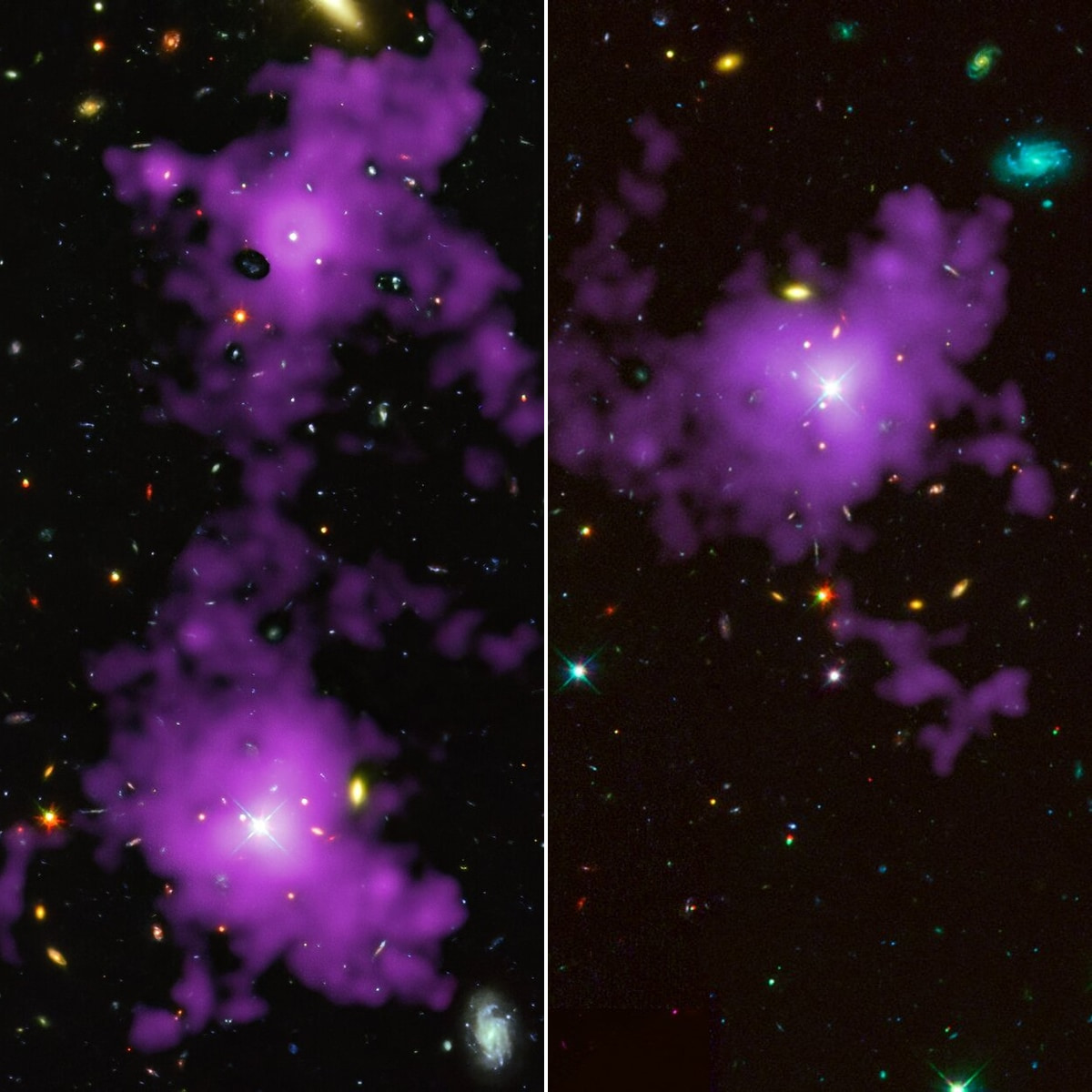
Astronomers have given scientists an unusually clear direct view of one of the universe’s hardest things to see: a faint gas filament in the cosmic web. The result does not mean dark matter itself has been photographed. Instead, it shows glowing gas that appears to trace the invisible structure shaped by dark matter’s gravity.
The finding matters because galaxies do not grow in isolation. In modern cosmology, they are thought to form and evolve inside a vast network of dark matter, gas, and galaxy clusters. This new observation offers a rare close look at part of that hidden network.
What happened
An international team of astronomers captured a high-definition view of a cosmic filament connecting two distant galaxies in the early universe. The galaxies are described as quasar-host galaxies, meaning each contains an active supermassive black hole at its center.
The study was led by Davide Tornotti of the University of Milano-Bicocca and involved scientists from institutions including the Max Planck Institute for Astrophysics. The team used MUSE, the Multi-Unit Spectroscopic Explorer, on the European Southern Observatory’s Very Large Telescope in Chile.
The filament spans about 3 million light-years. The light from the structure traveled for roughly 11 billion to just under 12 billion years before reaching Earth, meaning astronomers are seeing it as it existed when the universe was much younger.
The research was published in Nature Astronomy, with the paper titled “High-definition imaging of a filamentary connection between a close quasar pair at z = 3.”
The bigger picture
The cosmic web is the large-scale structure of the universe. It is often described as a network of filaments, sheets, and nodes, where matter is pulled together by gravity over billions of years.
Dark matter is central to this picture because it does not emit light but still has gravity. That gravity is believed to help shape the scaffolding where gas gathers and where galaxies form. The visible galaxies we see are only part of the full structure.
The challenge is that the gas between galaxies is extremely faint. Scientists often study it indirectly, such as by looking at how it absorbs light from bright objects behind it. A direct image of such a filament is therefore difficult and scientifically valuable.
Why this may be happening
This result was possible because of a combination of very deep observations, a powerful spectrograph, and a carefully chosen target. ESO says the image required about 150 hours of observations, while Max Planck described the work as one of the most ambitious MUSE campaigns in a single region of the sky.
MUSE is useful because it can separate light into many wavelengths across an area of sky. That helps astronomers detect faint signals from gas that would otherwise be lost in the background.
The two bright active galaxies also make the field especially useful for studying the gas around and between galaxies. However, that also means researchers need more observations before they can say whether this exact environment is typical of the wider cosmic web.
What it means
The image gives scientists a more detailed way to test ideas about how galaxies receive fuel. In theory, gas can flow along cosmic web filaments into galaxies, helping them form stars and grow over time.
The team compared the observation with supercomputer simulations. According to Max Planck, the comparison showed substantial agreement between current theory and the observed structure.
This does not solve every question about dark matter or galaxy formation. But it strengthens the link between models of the cosmic web and real observations of faint intergalactic gas.
What is still unclear
- Researchers still need more examples to know how common this kind of directly imaged filament is.
- It is not yet clear how gas flows through all cosmic web environments over time.
- The role of nearby active supermassive black holes needs careful study because they can affect surrounding gas.
- The image traces gas associated with the cosmic web, not dark matter itself.
- More observations will be needed to map how filaments connect to galaxies across different eras of the universe.
Final takeaway
The new cosmic web image is important because it turns a long-standing theoretical structure into something scientists can study in much sharper observational detail. It shows a faint bridge of gas between two early galaxies and helps explain how the hidden architecture of the universe may have guided galaxy growth.
The safest way to understand the finding is this: astronomers have not photographed dark matter directly, but they have captured one of the clearest views yet of gas tracing the cosmic web that dark matter helps shape.
Sources / references
- ScienceDaily, “First-ever direct image of the cosmic web reveals the Universe’s hidden highways” — https://www.sciencedaily.com/releases/2026/05/260516034136.htm
- Max Planck Society, “Researchers capture direct high-definition image of the Cosmic Web” — https://www.mpg.de/24060014/researchers-capture-direct-high-definition-image-of-the-cosmic-web
- European Southern Observatory, “Revealing a filament from the cosmic web” — https://www.eso.org/public/images/potw2504a/
- NASA ADS abstract, “High-definition imaging of a filamentary connection between a close quasar pair at z = 3” — https://ui.adsabs.harvard.edu/abs/2025NatAs…9..577T/abstract
- arXiv preprint, “High-definition imaging of a filamentary connection between a close quasar pair at z=3” — https://arxiv.org/abs/2406.17035